What Affects the Bio Bay Glow? The moon, the tides and your eyes.
What affects the glow in Puerto Rico's bioluminescent bays most is moonlight. A bright moon lights the sky and water around each faint flash, so the glow stands out less, and it is the factor you can plan. Next comes how much plankton is in the water. Tides matter too: our guides see tide conditions change the glow, most of all when sargassum drifts along the coast. Then your own eyes, which need 20 to 30 minutes in the dark.
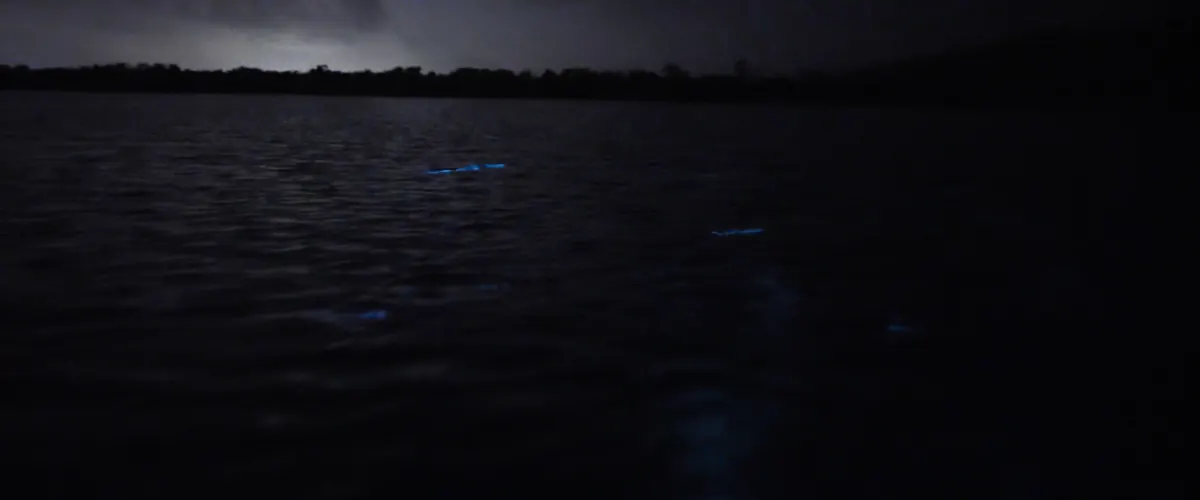
What matters most, ranked
Moonlight changes what you see the most, and it is the one factor you can plan years ahead. The number of plankton in the water matters as much, but it shifts over weeks and nobody can forecast it for one night. Tide conditions come next: our guides see them change the glow, most of all when sargassum drifts in. Then your eyes and lights on shore. Rain, wind and clouds matter mostly in storms.
| Factor | How much it changes what you see | Can you plan for it? | What to do |
|---|---|---|---|
| Moonlight | A lot. A bright sky hides the faint flashes. Strong evidence from how light and contrast work. | Yes, years ahead. | Pick a dark night on the moon calendar. In Fajardo, guides use a tarp on brighter nights. |
| Plankton in the water | A lot, over weeks. Counts swing widely between samples. Well studied. | Not for one night. | Nothing needed. Counts shift over weeks, not hours. |
| Tide conditions | Noticeable, our guides say, most of all when sargassum drifts in on the tide. An ordinary high or low tide is not measured. | Not far ahead. | Pick a dark night, then ask us about conditions for your dates. |
See all 7 factors
| Your eyes | Noticeable. Full night vision takes 20 to 30 minutes. Well studied. | Yes. | Keep screens off and let the glow build. |
|---|---|---|---|
| Lights on shore | Some. Light from land brightens the night sky. Named in Puerto Rico law. | Already handled. | Nothing. Special lighting zones protect all three bays. |
| Rain and wind | Not measured on ordinary nights. Big storms can dim a bay for weeks. | Partly, by forecast. | Watch the forecast. If we cancel for unsafe weather, you get a full refund. |
| Clouds | Unclear. They can hide the moon or reflect town light. No study at the bays. | Partly. | Plan for the moon and enjoy what the sky brings. |
We say the glow changes with moonlight, rainfall, wind and tides, and our guides see that on the water. What science has not measured yet is how much an ordinary high or low tide, with no sargassum, changes brightness on a given night.
We ranked these from published studies, NOAA and USGS data and Puerto Rico law, all linked below. Where the evidence is thin, the table says so. For how each flash works, see why the bio bay glows.
Does the moon affect bioluminescence?
The moon affects bioluminescence mainly through contrast. Moonlight brightens the sky and the water around each faint flash, so the blue-green glow stands out less. A full moon high in the sky gives about 0.05 to 0.2 lux, and up to about 0.3 lux on the best tropical nights. A moonless sky is lit only in thousandths of a lux, so a dark night gives the glow far more contrast.
Those figures come from a 2017 paper on how bright moonlight really is. Whether moonlight also makes the plankton flash less has not been measured in Puerto Rico's bays. In a lab study of another glowing plankton, Pyrocystis lunula, steady artificial light of 0.5 to 5 lux, a little above the strongest full moonlight, cut its glow by more than 40 percent, and somewhere between 25 and 100 lux stopped it. It is a different species under lamps, not moonlight, so it hints at an effect without measuring one in our bays.
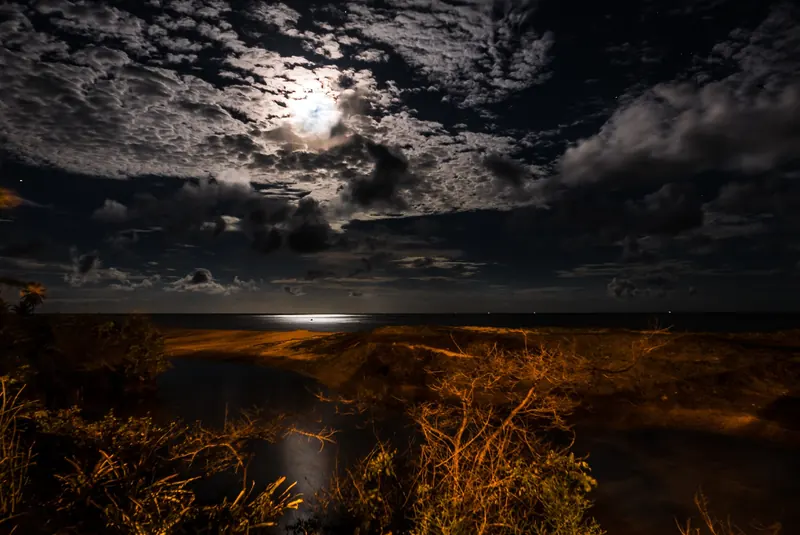

On brighter nights at Laguna Grande, our guides use a large tarp to block out the light so the group sees the glow. To choose a darker night, the bio bay moon calendar rates every night of your trip by the moonlight that reaches the water during tour hours.
Tonight's skySee the darkest nights on the moon calendarDoes the tide affect the bio bay?
Our guides, who paddle Laguna Grande every night, see tide conditions change the bio bay glow, most of all when sargassum is drifting along the coast. A study of Laguna Grande recorded exactly that: in 2015, flood tides carried sargassum into the lagoon, and the glowing plankton were absent from the lagoon while it was there.
What science has not measured is how an ordinary high or low tide, with no sargassum, changes brightness on a given night. The one direct test, a University of Puerto Rico thesis, sampled Laguna Grande over tidal cycles on three days of big tides: the tide carried plankton in and out of the channel, but the population inside the lagoon "does not change much". Over weeks, tides also flush the lagoon, and the higher tides of late summer and fall come with more plankton.
Is the bio bay better at high tide or low tide?
No study has compared high and low tide for brightness, so we cannot point you to one or the other. Puerto Rico's tides are small, and Laguna Grande runs hours behind the ocean. The plan that works: pick a dark night on the moon calendar, and let our guides keep an eye on the water. Questions about conditions for your dates? Message us on WhatsApp.
See the tide numbers for each bay
- Fajardo. NOAA's Fajardo station averages about 1.1 feet between high and low water, and about 1.5 feet from the day's higher high to its lower low (NOAA tidal datums). Most days bring two highs and two lows of unequal size, which NOAA calls a mixed tide.
- Inside Laguna Grande. The water rises and falls only about 5 to 16 inches over a tide, least in February and most in October, and high water arrives about 3.5 to 4 hours after the ocean's (USGS).
- Vieques. Near Mosquito Bay, NOAA's Esperanza station averages about 9 inches from higher high to lower low (NOAA). A study inside the bay measured one tide a day, from 4 to 18 inches (Keck Geology Consortium, 2007).
- La Parguera. NOAA's nearby Magueyes Island station averages about 8 inches from higher high to lower low (NOAA).
Where to check tonight's tide
NOAA publishes predicted high and low tides for its Fajardo station, number 9753216, near Las Croabas, where our Fajardo tour meets. Those times are for the open coast, so high water inside Laguna Grande comes about 3.5 to 4 hours later.
Why some weeks glow brighter than others
The number of glowing plankton in a bay rises and falls over weeks and months. At Laguna Grande, monthly counts from 2016 to 2021 ranged from about 4,400 cells per liter to about 2.2 million. The bays glow all year, and these swings are why no one can promise how bright a given night will be. Even so, on our Fajardo tour most guests see the glow on every tour.
Tides are part of this slow story. Laguna Grande trades water with the sea through one narrow channel and flushes its whole volume about every 6 to 11 days, faster in the high-tide season (USGS). In the 2016 to 2021 study, higher sea level, which peaks each year in late October, was the condition most clearly linked to more plankton, lower salinity also went with higher counts, and the authors infer that flushing by the higher tides of August to November helps (Govender and Jury, 2024).
Studies do not agree on the peak months. A 2003 to 2006 study found more glowing plankton mainly from April to September, with no clear link to any water condition it measured (Sastre and others, 2013), while the later study found August to November. For choosing a month, see the best time to see the bio bay.
The 2013 dip at Laguna Grande
In November 2013, Laguna Grande went dim for a few weeks. Puerto Rico's Department of Natural and Environmental Resources reported that from November 1 to 8, swells in the lagoon ran eight times above normal each day, moving the water and carrying the plankton out (DRNA, in Spanish). By early December the lagoon was glowing again, the Associated Press reported. It also went nearly dark in 2003 and rebounded a couple of months later (Christian Science Monitor). Each time, the bay came back.
How long do your eyes take to adjust to the dark?
Your eyes take about 20 to 30 minutes in darkness to reach full night sensitivity, a National Eye Institute researcher told Scientific American. The first few minutes bring a quick gain, and the rest builds slowly. On a bio bay tour, that means the glow looks stronger the longer you are out on the dark water.
How long it takes depends on how bright your surroundings were before, so keep your phone in its dry bag and let the glow build. The sky keeps darkening through the evening too. Our Fajardo tour runs an early and a late tour each evening. Both tours are in the bay in darkness, whichever time you book. Our guide to Fajardo bio bay tour times has the times by month.
Rain, wind, clouds and lights on shore
Rain, wind, clouds and shore lights matter less than the moon on an ordinary bio bay night. Guides say a shower adds flashes where the drops land, the evidence on wind and clouds is thin, and Puerto Rico's light-pollution law protects the dark around all three bays. Big storms are the exception: they can dim a bay for a few weeks before it recovers.
Rain, wind, clouds and lights in detail
Rain. The plankton flash wherever the water moves, and Vieques guides told NPR that when it rains, the whole surface of the water is alight. Big storms such as Hurricane Maria can dim a bay for a spell before it recovers, as our rain and weather guide explains.
Wind. The 2016 to 2021 Laguna Grande study linked light winds with more plankton over the season. No study we found tested a breezy evening against brightness. On the water, a breeze mostly means a little more paddling.
Clouds. Clouds can hide a bright moon, which helps. Near towns they can also bounce light back down: one measurement near Vienna, cited in the same moonlight paper, found overcast skyglow about as bright as full moonlight. No one has measured this at Puerto Rico's bays, so plan around the moon and treat clouds as a wild card.
Lights on shore. Light from land brightens the night sky, much like moonlight. Puerto Rico's light-pollution law, Ley 218 of 2008, says artificial light harms the bio bays and sets special lighting zones for all of Vieques and for a five-mile radius around La Parguera and around Laguna Grande.
Best conditions to see bioluminescence
The best conditions are a dark sky, settled weather and eyes that have had time to adjust. Two of those are yours to plan: a night when the moon is down during tour hours, and 20 to 30 minutes away from screens. The plankton count is up to nature. Book a dark night early in your trip, so you still have evenings free if the weather turns; cancellation is free up to 24 hours before your tour.
Pick a dark night
Open the bio bay moon calendar, enter your dates and note the darkest nights, the best nights for your trip, ideally early on.
Book the first one
Our Fajardo kayak tour runs every night of the year and books online, with free cancellation up to 24 hours before your tour and a full refund if we cancel for unsafe weather.
Choose the tour for where you are staying
Fajardo is a good fit for San Juan and the east coast, with hotel pickup available. Staying on Vieques? The Mosquito Bay clear-kayak tour is for nights you sleep on the island. Heading southwest? The La Parguera sunset boat tour runs on select nights each month and books by message.
What are bio bay conditions tonight?
For tonight, look at the moon calendar for moonlight during tour hours and a weather forecast for storms, and ask us about the water: our guides are on Laguna Grande every night. Wondering what the night is really like? Read is the bio bay worth it.
What affects the bio bay glow: questions
Does the tide affect the bio bay?
Yes. Our guides, who paddle Laguna Grande every night, see tide conditions change the glow, most of all when sargassum is drifting along the coast. A study found the glowing plankton absent while flood tides carried sargassum into the lagoon in 2015. How much an ordinary high or low tide changes brightness has not been measured.
Does sargassum affect the bio bay?
Yes. Our guides on Laguna Grande see tide conditions affect the glow most of all when sargassum is drifting along the coast. A study recorded it in 2015: flood tides carried sargassum into the lagoon, and the glowing plankton were absent while it was there. Questions about conditions for your dates? Message us on WhatsApp.
Is the bio bay better at high tide or low tide?
Neither high nor low tide has been shown to be better for the bio bay glow. No study has compared them for brightness, and the one direct test found the plankton count inside Laguna Grande changed little over a tidal cycle. Our guides watch tide conditions every night, so pick a dark night and ask us about your dates.
Does the moon affect bioluminescence?
Yes, the moon changes how much of the glow you see. Moonlight brightens the sky and the water around each faint flash, so it stands out less. Whether it also makes the plankton flash less has not been measured in Puerto Rico's bays. A full moon gives about 0.05 to 0.3 lux; a moonless sky, thousandths of a lux.
What are bio bay conditions tonight?
Bio bay conditions tonight come down mostly to the moon, plus the weather and the water. Puerto Rico's three bays glow year-round. Check our moon calendar for moonlight during tour hours and a weather forecast for storms, then message us on WhatsApp: our guides see the water every night, including any sargassum.
What are the best conditions to see bioluminescence?
The best conditions are a dark sky, settled weather and 20 to 30 minutes for your eyes to adjust. Pick a night when the moon is down during tour hours, keep screens off once you are on the water, and leave an evening free in case the weather turns. Puerto Rico's three bays glow all year.
Does rain affect bioluminescence?
Puerto Rico's bio bays keep glowing in a passing shower, and guides say the drops add flashes of their own where they stir the water. Big storms are different and can dim a bay for a spell before it recovers. If we cancel a tour for unsafe weather, you get a full refund.
Does wind affect the bio bay?
On an ordinary night, no study we found links wind to how bright Laguna Grande or the other bays look. A 2016 to 2021 study there linked light winds with more plankton over a season, which is a slow effect. What a breeze does change on the night is the paddle, so dress for a little spray.
Is the bio bay glowing right now?
Puerto Rico's three bio bays glow year-round. How much you see on a given night depends mostly on the moon, plus the weather and a plankton count that shifts over weeks. On our Fajardo tour, most guests see the glow on every tour. Our moon calendar rates tonight's moonlight during tour hours.
How bright is the bio bay?
How bright the bio bay looks depends on the night, because monthly plankton counts at Laguna Grande have ranged from about 4,400 to 2.2 million cells per liter. Each flash is faint and lasts about a tenth of a second, so the glow shows best on a dark night, around your paddle, hand and kayak.
How long does it take your eyes to adjust to the dark?
About 20 to 30 minutes to reach full night sensitivity, according to a National Eye Institute researcher. The first few minutes bring a quick gain, and the rest builds slowly. On a bio bay tour, that means the glow looks stronger the longer you are on the dark water, so keep your phone screen off.
Do clouds make the bio bay darker?
Sometimes: clouds can hide a bright moon, which helps the glow stand out, but near towns they can also reflect light back down. One measurement near Vienna found overcast skyglow about as bright as full moonlight. No study has measured clouds at Puerto Rico's bays, so plan around the moon first.
Why did the Fajardo bio bay go dark in 2013?
A long spell of heavy swell carried the plankton out of Laguna Grande. Puerto Rico's natural resources department reported that from November 1 to 8, 2013, swells in the lagoon ran eight times above normal each day. Scientists found it was not caused by people, and by early December the lagoon was glowing again.
Where can I check the tide in Fajardo tonight?
NOAA publishes predicted high and low tides for its Fajardo station, number 9753216, on its Tides and Currents website. Those times are for the open coast: inside Laguna Grande, high water comes about 3.5 to 4 hours later. Our guides watch the water every night, so ask us about conditions for your dates.
Pick a dark night, then enjoy the glow
Our Laguna Grande kayak tour runs every night of the year. Book online: choose your date, the early or late tour, and drive yourself or add hotel pickup.